How much should our family leave from the Tooth Fairy?
A 2026 U.S. survey average, a repeatable family budget and simple words for different tooth-night plans.
Sathian Srikrishnan, dad and founder · Updated
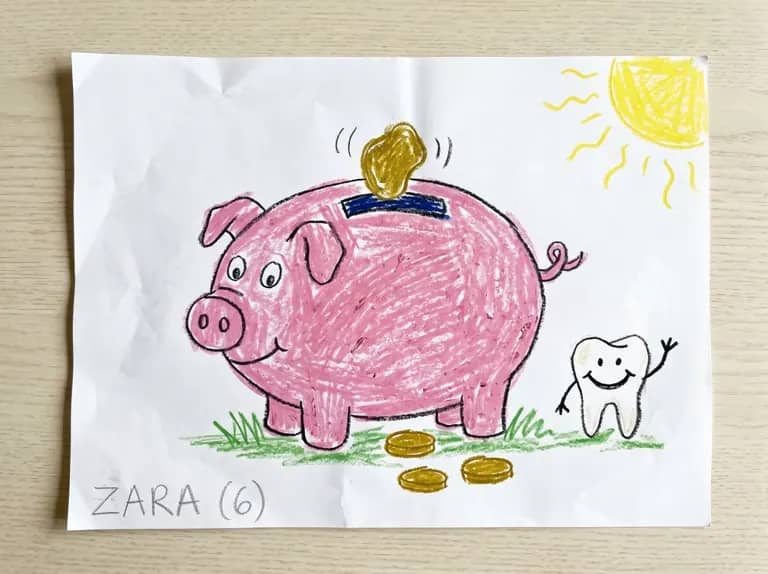
Choose an amount that fits your budget and that you are happy to repeat. You can mark a lost tooth with a note or drawing as well as money. Your family does not need to match another family's rate.
Start here
The useful number is the one that works in your home. Start with the plan, then choose the amount.
What does the 2026 survey say?
Delta Dental’s 2026 U.S. poll reported an average of US$5.84 for one lost tooth. The survey ran from January 5–15, 2026, with 1,000 parents of children ages 6–12. It also reported a US$7.17 average for a first tooth.
Those are survey averages, not a price list. They do not tell you what every child received. They are not a Canadian rate or a rule for your home. Pick what fits your budget and what you want to repeat.
Make three small decisions
First, decide what you want the ritual to feel like. Is it a little surprise, a chance to save a small amount, or a keepsake of a milestone? You can have more than one aim, but keep the plan easy to do on a busy evening.
Second, decide whether the first tooth is different from later teeth. A special first note may mark the milestone without a larger amount.
Third, choose what you can repeat. Think about the whole family and future tooth nights, rather than only tonight's excitement. If money is tight, the note can carry more of the moment.
Use a clear family rule
Write it down privately so other adults know it too. You might use a fixed amount for each tooth, a small gift chosen each time, or a note with an occasional keepsake. Choose what suits your home.
A made-up example: a parent chooses a small fixed amount and a three-line note. For the first tooth, they add the date and save a drawing. Later tooth nights use the same amount and a shorter note. The extra meaning comes from the record, not an amount that has to keep rising.
What to say when a cousin gets more
Try: “Families do this in different ways. This is our family's Tooth Fairy plan.”
If the child is disappointed, you can hear that without changing the amount. “You hoped for the same as your cousin. I understand. Our plan is this.” Then return to their own tooth story or what they want to do with the gift.
You do not need to explain another family's choices or suggest that one child deserved more. Keep it about the plan in your home.
Plan for the night you have no cash
Keep a spare note or envelope if that helps. Agree with another adult what to do when you cannot give the usual thing straight away.
You could leave a note explaining what will happen next in your family's chosen voice. Use a promise you can keep. A clear small plan is easier for a child to understand than a new surprise that you have to repair later.
Let the child choose what happens next
Ask whether they want to use the gift soon or keep it toward something. Keep the choice concrete: “Would you like to put it toward the art set, or choose a little treat with us?”
You can record the choice on a card. If they change their mind, talk it through within your family rules. The conversation can be a small way to practise choosing.
Keep grandparents in the loop
Tell relatives your plan before they add their own Tooth Fairy message. A grandparent can mark the milestone with a gift from themselves, a call or a note. That gives the child a clear story about who gave what.
Common questions
What is the average amount this year?
The 2026 U.S. poll above reported US$5.84. Your family can choose another amount. The survey is context, not a bill you have to match.
Should the amount change for different teeth?
It can, if that is your family plan. A fixed rule may be easier to remember and explain.
Can we give something without cash?
Yes. A note, drawing or small family ritual can mark the day. If you want a printed keepsake later, see the Proof gift.
Where can I find a simple tooth-night plan?
Use the first lost tooth checklist for the note, memory and family message.